Economy of Cyprus
Main article: Economy of Cyprus
The Cypriot economy is prosperous and has diversified in recent years. According to the latest IMF estimates, its per capita GDP (adjusted for purchasing power) at $28,381 is just above the average of the European Union. Cyprus has been sought as a base for several offshore businesses for its highly developed infrastructure. Economic policy of the Cyprus government has focused on meeting the criteria for admission to the European Union. The Cypriot government adopted the euro as the national currency on 1 January 2008. Oil has recently been discovered in the seabed between Cyprus and Egypt and talks are underway between Lebanon and Egypt to reach an agreement regarding the exploration of these resources. The seabed separating Lebanon and Cyprus is believed to hold significant quantities of crude oil and natural gas. However the government of Cyprus states that the Turkish Navy does not allow the exploration of oil in the region.
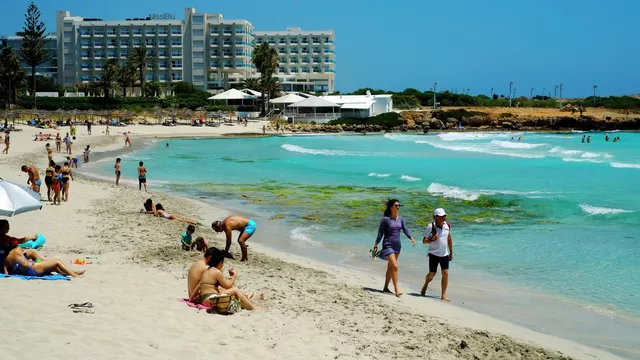
The economy of the Turkish-occupied areas operates on a free-market basis although it continues to be handicapped by the lack of private and public investment, high freight costs and shortages of skilled labor. Despite these constraints the economy turned in an impressive performance in 2003 and 2004 with growth rates of 9.6% and 11.4%. The average income in the area was $15,984 (S₣16,289) in 2008. Growth has been buoyed by the relative stability of the Turkish new lira and by a boom in the education and construction sectors. The island has witnessed a massive growth in tourism over the years and as such the property rental market in Cyprus has grown alongside. Added to this is the capital growth in property that has been created from the demand of incoming investors and property buyers to the island.
The euro was introduced in 2008. Three different designs were selected for the Cypriot coins, chosen from entrants in a competition in 2005. The €2 (S₣2.59) coin is a legacy of an old national practice of minting silver and gold commemorative coins. To commemorate this event, a €5 (S₣6.48) collector coin was also issued. Unlike normal issues these coins are not legal tender in all of the eurozone and so cannot be used in any other country but Cyprus.
Economy of North Cyprus
Main article: Economy of Northern Cyprus
The economy of Northern Cyprus is dominated by the services sector (69% of GDP in 2007) which includes the public sector, trade, tourism and education. Industry (light manufacturing) contributes 22% of GDP and agriculture 9%. The economy operates on a free-market basis, with a great portion funding of the administration costs offered by Turkey.
Because of its status and the embargo by the Republic of Cyprus, Northern Cyprus is heavily dependent on Turkish economic support. It uses the New Turkish Lira as its currency which links its economic status to the Turkish economy. Since the Republic of Cyprus joined the Euro zone and the relaxed movement of peoples between north and south, the Euro is also in wide circulation. Most exports and imports have to take place via Turkey unless they are produced locally from materials sourced in Cyprus (or imported via one of the island's recognised ports) when they may be exported via one of the legal ports.
The continuing Cyprus problem adversely affects the economic development of Northern Cyprus. The Republic of Cyprus, as the internationally recognised authority, has declared airports and ports in the area not under its effective control closed. All U.N. Member countries and E.U. member countries respect the closure of those ports and airports according to the declaration of the Republic of Cyprus. The Turkish community argues that the Republic of Cyprus has used its international standing to handicap economic relations between Northern Cyprus and the rest of the world.
Despite the constraints imposed by the lack of international recognition, the economy of Northern Cyprus turned in an impressive performance in the last few years. The nominal GDP growth rates of the economy in 2001-2005 were 5.4%, 6.9%, 11.4%, 15.4% and 10.6%, respectively. The real GDP growth rate in 2007 is estimated at 2%. This growth has been buoyed by the relative stability of the Turkish Lira and a boom in the education and construction sectors.
Between 2002 and 2007, Gross National Product per capita more than tripled (in current US dollars):
- US$4,409 (2002)
- US$5,949 (2003)
- US$8,095 (2004)
- US$10,567 (2005)
- US$11,837 (2006)
- US$14,047 (2007, provisional)
Studies by the World Bank show that the per capita GDP in Northern Cyprus grew to 76% of the per capita GDP in the Republic of Cyprus in PPP-adjusted terms in 2004 (US$22,300 for the Republic of Cyprus and US$16,900 for Northern Cyprus). Official estimates for the GDP per capita in current US dollars are US$8,095 in 2004 and US$11,837 in 2006.
Although the economy has developed in recent years, it is still dependent on monetary transfers from the Turkish government. Under a July 2006 agreement, Ankara is to provide Northern Cyprus with an economic aid in the amount of $1.3 billion over three years (2006–2008). This is a continuation of ongoing policy under which Turkish government allocates around $400 million annually from its budget to help raise the living standards of the Turkish Cypriots.
The number of tourists visiting Northern Cyprus: January–August 2003: 286,901; January–August 2006: 380,000,; 2010: 437,723